

Today, the leaders of all 32 NATO countries gather in Ankara, Turkey. They meet behind a security lockdown so severe that the Ankara governorship banned all rallies, demonstrations, and even leaflet distribution for nearly two weeks. In the days before the summit, anti-NATO protests broke out in Istanbul, Ankara, and Izmir — ordinary people opposing ever-higher military budgets.
Think about that. A military alliance meets to discuss “security,” and the first thing it secures is silence.
And what is on the official agenda for day one? The NATO Summit Defence Industry Forum — the alliance’s own words: its “premier high-level event on transatlantic defence production, investment and innovation.” They are not even hiding it anymore. The summit opens with an arms bazaar.
So I asked a simple question, and I used the power of AI to help me answer it: over the past 250 years, how many years has each of these 32 nations spent in war and armed conflict?
The chart below is the answer. Look at it. Sit with it.

A note on the numbers: No official dataset of “years at war” exists. The chart above uses a broad, consistent definition — any year a country’s armed forces were engaged in combat, including colonial wars and overseas deployments — and counts predecessor states (Prussia for Germany, the Ottoman Empire for Türkiye). Figures are estimates, accurate to within roughly 15–20 years, and are meant to show the pattern, not the decimal point. Tighten the definition to formally declared wars only and every number collapses — which itself tells you how normalized permanent, undeclared war has become.
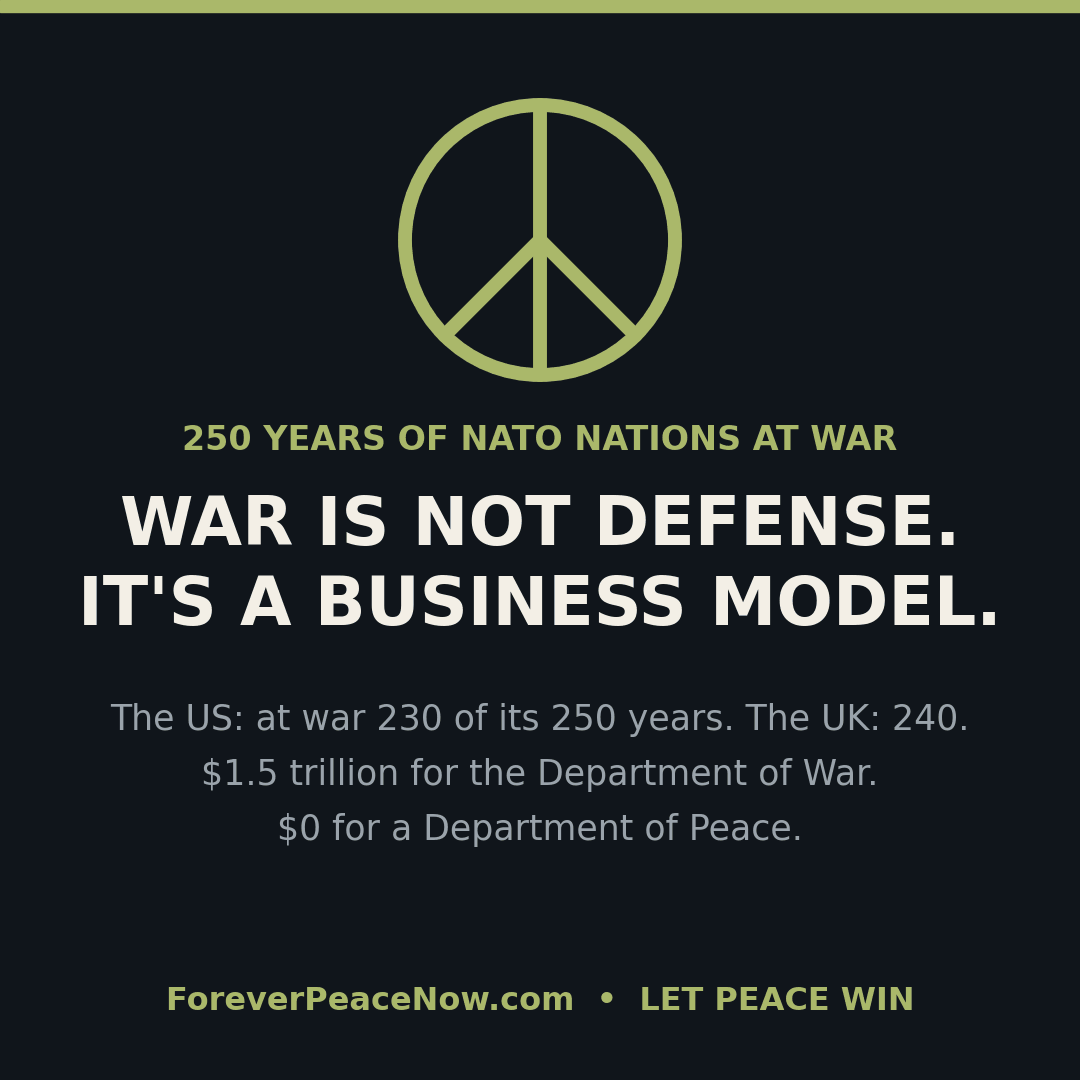
The United States has spent roughly 230 of its 250 years — about 92% of its entire existence — engaged in war or armed conflict somewhere on this Earth. From the Indian Wars waged against the original inhabitants of this land, to the endless interventions, occupations, and “operations” that followed, war is not an interruption of American history. War is American history.
As advertised: The Department of War
So when Defense Secretary Pete Hegseth rebranded the Department of Defense as the Department of War by executive order in September 2025, I found myself in rare agreement with this administration. For once, truth in advertising. The Pentagon even publishes its press releases at war.gov now. It is finally as advertised.
And where does this culture come from? Look at the top of the chart. The record holder is not the United States — it is our “greatest ally,” the British Empire, at war somewhere in the world for roughly 240 of the last 250 years. There was scarcely a single year between 1776 and 1945 without British forces fighting someone, somewhere — India, Africa, Asia, the Napoleonic Wars, an endless catalogue of colonial campaigns. The United States was born from that empire, inherited its settler-colonial mentality, and perfected it. The apple did not fall far from the tree. The apple is the tree.
July 3, 1979: The day we planted the seeds of September 11
On July 3, 1979, President Jimmy Carter — at the urging of National Security Adviser Zbigniew Brzezinski — signed the first directive of what became Operation Cyclone: covert aid to the opponents of the pro-Soviet government in Afghanistan. This was nearly six months before the Soviet invasion. Brzezinski himself later boasted, in a 1998 interview, that the aid was designed to draw Moscow into the “Afghan trap” — to give the Soviet Union its own Vietnam War. Historians still argue over how deliberate the trap was. The Afghan people are not arguing. They lived the consequences.
Billions of dollars flowed through Pakistan’s intelligence services to the mujahideen. And when the Soviets finally left, we walked away and left behind a shattered country, a generation trained for war, and a battlefield swarming with armed, radicalized networks. Out of that wreckage rose the Taliban in the 1990s, and out of the Arab volunteer networks that had gathered around that same jihad rose al-Qaeda. This is what the CIA itself calls blowback. The hand that fed the war got bitten on September 11, 2001 — and nearly 3,000 innocent people paid with their lives for decisions made in Washington two decades earlier.
Article 5 and the 20-year war
For the first and only time in its history, NATO invoked Article 5 — collective defense — after September 11. In good faith, soldiers from nearly every country on my chart went to Afghanistan. That is why so many small nations — Estonia, Latvia, Lithuania, Slovenia, Croatia, North Macedonia — have 10 to 15 years of war on their ledger. Almost all of it is Afghanistan.
And what did 20 years of war achieve? According to Brown University’s Costs of War project, over 176,000 people died in the Afghanistan war zone, including more than 46,000 civilians, and the United States alone spent over $2.3 trillion. Then, in August 2021, we handed the country back to the very Taliban we went to fight — abandoning the Afghan people, especially Afghan women and girls, to their mercy. The Pentagon’s own report admits that roughly $7 billion worth of American military equipment was left behind in Taliban hands.
Hundreds of thousands of lives. Trillions of dollars. The hopes and dreams of an entire generation of Afghans. All of it destroyed in a 20-year war waged, in the end, to correct the blowback from a covert program signed into existence on July 3, 1979.
Now comes the bill: 5% of GDP and a $1.5 trillion war machine
Having led its allies into that catastrophe, the United States government now demands they pay for the next one. At last year’s Hague summit, NATO members pledged to raise military spending to 5% of GDP — and in Ankara today, the pressure is to deliver. Some allies are racing to hit 5% this year, a decade ahead of schedule. NATO’s own Secretary General boasts that European allies and Canada have poured an additional $1.2 trillion into their militaries over the past decade.
Where will this money go? Follow it. It flows to the American military-industrial complex — Lockheed Martin, Boeing, RTX (Raytheon), Northrop Grumman, General Dynamics — and increasingly to Big Tech’s newest war profiteers: Palantir and the Silicon Valley companies I write about in my forthcoming book. The same industry that opens this very summit with its “Defence Industry Forum.”
And at home? The administration’s Fiscal Year 2027 budget requests $1.5 trillion for the Department of War — a 42% increase in a single year, the largest war budget since World War II — paid for, in part, by a proposed 10% cut to domestic programs. More guns, less bread. More missiles, fewer schools and hospitals. A war machine financed by debt while veterans sleep on our streets. I know something about sleeping where no one should have to sleep. I wrote a book about it.
Here is the question no one in Ankara will ask
Since 1945, the United States has not won a single major, protracted war. Korea ended in stalemate. Vietnam in defeat. Afghanistan in defeat. Iraq in chaos and the birth of ISIS. Eighty years of evidence, trillions of dollars, millions of lives — and the answer from Washington is always the same: more.
America once flirted with a different answer. Benjamin Rush — a signer of the Declaration of Independence — proposed a Peace Office for the United States back in 1793. Congressman Dennis Kucinich introduced legislation for a Department of Peace year after year. We even built a United States Institute of Peace — and in 2025, this administration gutted it, firing its staff and seizing its building, even as the courts pushed back.
We renamed the Department of War honestly. Now let us be honest about what is missing: a Department of Peace and Diplomacy, funded not with crumbs but with conviction. Imagine 5% of GDP pledged to conflict prevention, to diplomacy, to rebuilding what war has broken. Imagine a NATO summit that opened with a Peace Industry Forum.
The 32 leaders in Ankara will not ask this question. So we must. Sign the petition at ForeverPeaceNow.com/Petition. Visit ParentsPlea.com and look into the faces of the children war leaves behind. And on Hiroshima Day, August 6, join me for the release of NO ETHICS IN BIG TECH — because the war machine now runs on code, and the people writing that code answer to us.
Two hundred and fifty years is enough.
Let peace win.
By Vahid Razavi — ForeverPeaceNow.com | ParentsPlea.com | Author of The Age of Nepotism, Ethics in Tech and Lack Thereof and the forthcoming NO ETHICS IN BIG TECH (releasing Hiroshima Day, August 6, 2026)