
On Hiroshima, Nagasaki, the Machine That Built the Bomb, and the One We Are Building Now
I want to tell you why this book is being released on August 6th.
Not because of symbolism. I have spent years organizing events on Hiroshima Day. In August 2020 — the 75th anniversary — I hosted what became the first in a series of annual commemorations: Ignominious Anniversary: Remembering Hiroshima and Imagining a World Without Autonomous Killer Robots, Nuclear Weapons and Blanket Surveillance. We organized it in partnership with Mines Action Canada and the Campaign to Ban Killer Robots. Cindy Cohn, the Executive Director of the Electronic Frontier Foundation, was among our speakers. So was Rev. Dr. Dorsey Blake, Brett Wilkins, and Janet Weil — peace advocates, lawyers, journalists, and activists who understood, as I did, that the anniversary of Hiroshima was not a history lesson. It was a living warning.
In 2022, we returned with Remembering Hiroshima: An Evening of Hope and Activism through the Electronic Frontier Alliance. In 2023, I had the profound honor of sharing a panel with Takashi Tanemori — a man who survived the bombing of Hiroshima less than a mile from ground zero, lost his parents in the blast, and spent the rest of his life teaching peace through forgiveness, not because forgiveness came easily, but because he understood that the alternative was to let the bomb win twice. Once on the morning it fell. Once in the soul of every survivor who chose hatred over healing.
I have sat in rooms with survivors. I have heard what August 6th, 1945 produced in real human bodies and real human families. I do not invoke Hiroshima lightly.
I invoke it because it is the only honest frame for what I am describing in this book.
Two Cities. Three Days. One Warning the World Has Still Not Heeded.
On August 6, 1945, at 8:15 in the morning, the United States dropped an atomic bomb called Little Boy on Hiroshima. The city was destroyed. Between 90,000 and 166,000 people died by the end of that year — many instantly, many more slowly, from burns, radiation, and wounds the medicine of that era could not treat. The shadows of people standing on the steps of buildings were burned into the stone.
Three days later, on August 9th, a second bomb — Fat Man — fell on Nagasaki. An estimated 60,000 to 80,000 people died immediately. Tens of thousands more in the weeks and months that followed. Two cities. Two bombs. Three days apart.
This is the part that history sometimes allows to collapse into a single event. It was not a single event. It was a decision made twice — the second time with the full knowledge of what the first had produced. Three days was enough time to know. It was not enough time to stop.
I think about that decision often. I think about what it means to know, fully and completely, what a technology does to human beings — to have seen the photographs, heard the reports, received the casualty numbers — and to deploy it again anyway. Not out of ignorance. Out of the calculation that the outcome was acceptable.
That calculation — the one that says the cost in other people’s lives is a number we can absorb and continue — is the same calculation that Lockheed Martin CEO Jim Taiclet made when he told investors that the current moment of mass killing is a “golden opportunity.” It is the same calculation embedded in Palantir’s targeting algorithms, which assigned threat scores to tens of thousands of Palestinians and accepted a ten percent error rate as operationally tolerable. It is the same calculation made by the engineers who built those systems and the executives who signed the contracts.
The technology changes. The logic does not.
The Bomb Was Also Built in the Bay Area
Here is the fact that Silicon Valley’s mythology does not include in its origin story.
The Lawrence Livermore National Laboratory — located in Livermore, California, forty miles from San Francisco — was established in 1952 as a nuclear weapons design laboratory. It is part of the University of California system, founded by physicists Edward Teller and Ernest Lawrence to accelerate America’s nuclear weapons program alongside Los Alamos National Laboratory in New Mexico, birthplace of the original atomic bomb under the Manhattan Project. These were not distant institutions. They were built in the same geography, funded by the same government, operated by the same university system that would later produce the intellectual infrastructure of Silicon Valley.
The people who built the internet and the people who built the bomb were not strangers. They were colleagues, neighbors, successors — products of the same Bay Area and Berkeley institutional culture that has always understood technology primarily as an instrument of national power. The PayPal Mafia did not emerge from nowhere. They emerged from a geography with a specific and documented relationship between private capital, military contracts, and the university system. Palantir was founded with CIA venture capital. The cloud infrastructure sold to the Israeli military runs on servers built in the same industrial tradition that produced the warheads. Silicon Valley simply updated the product line.
What Oppenheimer Understood Too Late
J. Robert Oppenheimer watched the first nuclear test at Trinity, New Mexico on July 16, 1945, and recalled a line from the Bhagavad Gita: Now I am become Death, the destroyer of worlds. A man of towering intellect, confronting in a single moment the full weight of what his work had enabled.
Three weeks later the bomb fell on Hiroshima. Then Nagasaki. And then the full reckoning arrived — not the explosions themselves, but the understanding that what had been built could not be unbuilt. That the knowledge was now in the world. That the only question remaining was governance: who controlled it, under what rules, with what consequences for violation.
The Non-Proliferation Treaty was not signed until 1968. Twenty-three years after Hiroshima. In the gap between Trinity and that treaty, the Soviet Union had the bomb, China had the bomb, and civilization arrived at a condition of mutual assured destruction so complete that the only thing preventing its end was the rationality of the people holding the triggers.
We are in that gap again. And this time, I am not sure rationality is on offer.
Anthropic — the company whose AI I am using to edit this book — has described a six-to-eighteen month window before next-generation AI capabilities proliferate beyond the organizations currently developing them. There is no international governance framework. There is no binding treaty. There is no equivalent of the IAEA conducting inspections and certifying compliance. There is Elon Musk’s Grok producing Holocaust denial. There is DeepSeek releasing open-source AI that any actor in the world can weaponize. There is OpenAI quietly removing the prohibition on military use from its terms of service. There is Google’s Gemini being used to analyze drone surveillance footage for an active military. There is Palantir’s CEO publishing a 22-point manifesto calling endless war the highest calling of Western civilization.
The scientists who built the bomb believed they were in a race against fascism. They were right about the race. They did not fully anticipate what winning would cost — not just Hiroshima and Nagasaki, though that cost alone should have been enough to stop everything — but in the decades of arms proliferation, proxy wars, nuclear brinkmanship, and normalized militarism that followed. The technology escaped the intentions of its creators the moment it was deployed. Every subsequent generation inherited the consequences.
We are making the same mistake. Faster. With fewer restraints. And with men in charge who, unlike Oppenheimer, show no sign of conscience, late or otherwise.
The Difference This Time
In 1945, the bomb was a physical object. It required specific materials — uranium, plutonium — that existed in limited quantities at specific locations. It required industrial infrastructure that could be monitored, inspected, and sanctioned. The Non-Proliferation Treaty worked, imperfectly but measurably, because the physical constraints of nuclear weapons gave governance a fighting chance.
AI has no such constraints.
The knowledge is already distributed. The models are already in the hands of state and non-state actors who operate outside any governance framework that currently exists or is being seriously proposed. The same architecture that allows an AI system to help a nurse navigate a medical database also allows a government to build mass surveillance infrastructure, a military to automate targeting decisions at scale, a platform to algorithmically suppress the testimony of an entire besieged people, and a corporation to generate deepfake intimate imagery of children. The architecture does not distinguish. The question is only who is asking and what they intend.
When I asked an AI to make the best argument for love, it produced something luminous. The same architecture, in the hands of Elon Musk, produced Holocaust denial. In the hands of the Israeli military’s cloud account, it analyzed drone surveillance footage. In the hands of Chinese state-sponsored actors, it developed offensive scanning tools and phishing attacks.
The AI reflects the asker. The asker reveals their values. And the men who currently control the most powerful AI systems in the world — I have documented their values across eighteen chapters. They have not hidden them. They have put them in earnings calls and corporate manifestos and investment agreements and no-bid government contracts and the bodies of children in Rafah.
Why August 6th
I am releasing this book on August 6, 2026 — the 81st anniversary of the bombing of Hiroshima, three days before the anniversary of Nagasaki — because I want every person who picks it up to hold two things in their mind at the same time.
The first is what unchecked power in the hands of men without conscience produced across those three days in August 1945. The children who went to school and did not come home. The shadows burned into the stone steps of the Sumitomo Bank building — the only physical trace remaining of human beings who were standing there at 8:15 in the morning. The hibakusha — a word the Japanese language had to invent, because no word previously existed for that category of human experience: bomb-affected person. Hiroshima. Then Nagasaki. Three days apart. The same decision made twice.
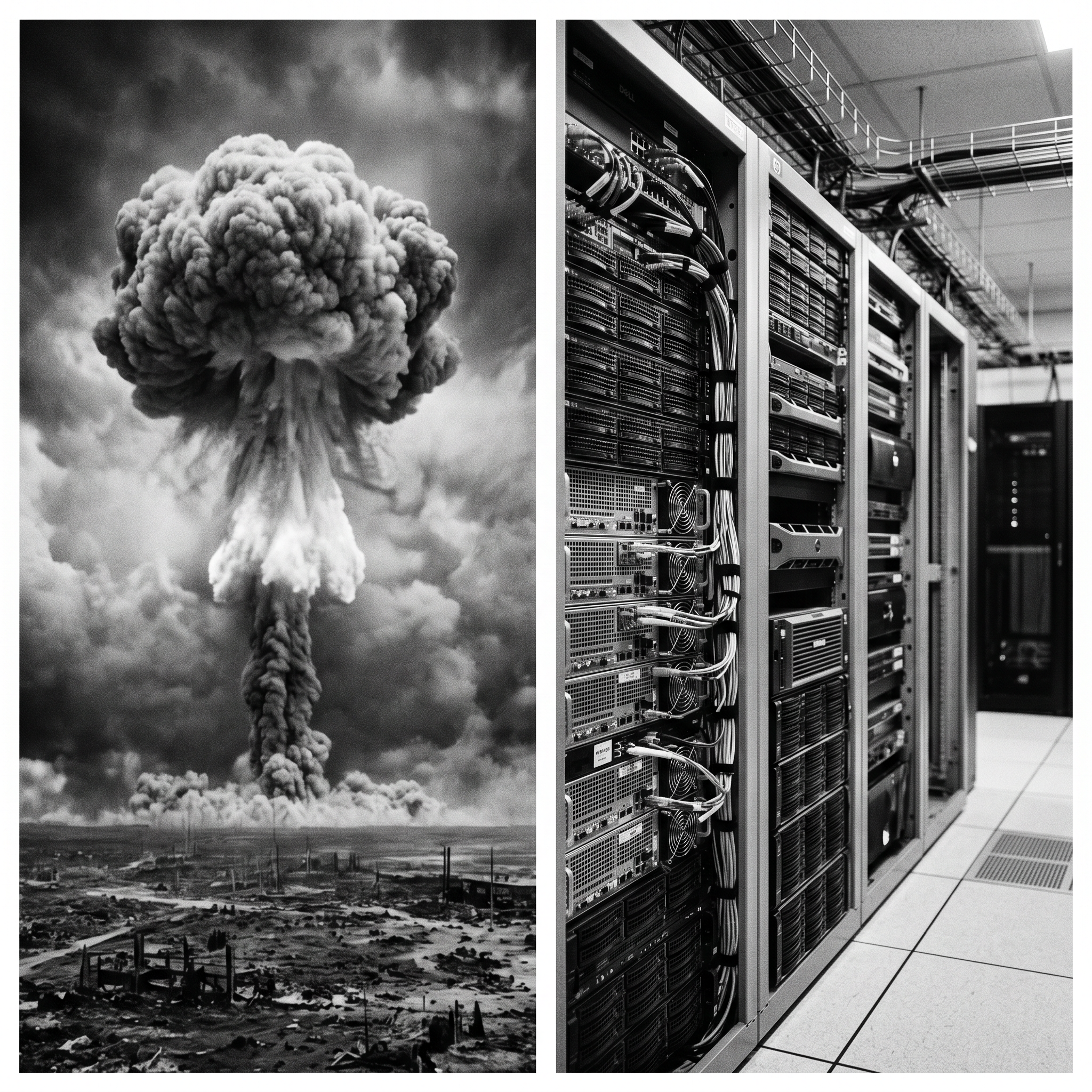
The second is what is being built right now, in the data centers and boardrooms of Silicon Valley and its international equivalents, with no Oppenheimer moment on the horizon. No conscience. No flash of recognition. No ancient text quoted in the desert at the moment of detonation.
The difference between 1945 and now is not that the stakes are lower. The difference is that the bomb required a government, a military, a physical supply chain, and the political decision of a head of state. The AI systems being built today require none of that. They require a server farm and a terms-of-service agreement — and the terms of service can be changed on a Tuesday afternoon with no press release.
Hiroshima and Nagasaki happened in three days, to two cities, and the world spent the next eighty years trying to ensure it never happened again. What is being built in Silicon Valley today is not a weapon aimed at two cities. It is infrastructure aimed at the conditions of human freedom itself — the right to speak, to be seen, to grieve, to resist, to be counted among the living, to not be a line item in a targeting algorithm’s acceptable loss calculation.
If we do not govern it — not nudge it, not publish ethics guidelines, not create voluntary commitments that are revised whenever they become inconvenient — but actually govern it, with binding international law, with criminal accountability for the executives who deploy it in violation of human rights, with the same hard-won seriousness that the post-Hiroshima world eventually applied to nuclear weapons — then we will not have another Hiroshima and Nagasaki.
We will have something the world has no word for yet.
I have spent years organizing Hiroshima Day events because I believe that remembrance without action is not remembrance. It is performance. Takashi Thomas Tanemori survived less than a mile from ground zero and spent the rest of his life teaching peace through forgiveness. Not because forgiveness came easily. Because he understood that the alternative was to let the bomb win the war it was really fighting — the one against the human soul.
I am not a survivor of Hiroshima or Nagasaki. I am a survivor of Silicon Valley. And what I have seen in thirty years inside this machine is enough to tell me that the arc of what is being built does not bend toward humanity on its own.
It bends because people push it.
This book is me pushing.
August 6, 2026.
Evil men and their machines do not prevail. But they do not stop on their own.
Vahid Razavi is the founder of No Ethics in Big Tech, Ethics in Technology, ParentsPlea.com, and GoAmour.com. He is the author of The Age of Nepotism and Ethics in Tech and Lack Thereof. No Ethics In Big Tech will be his third book. | View His Documentary ForeverPeaceNow.com